
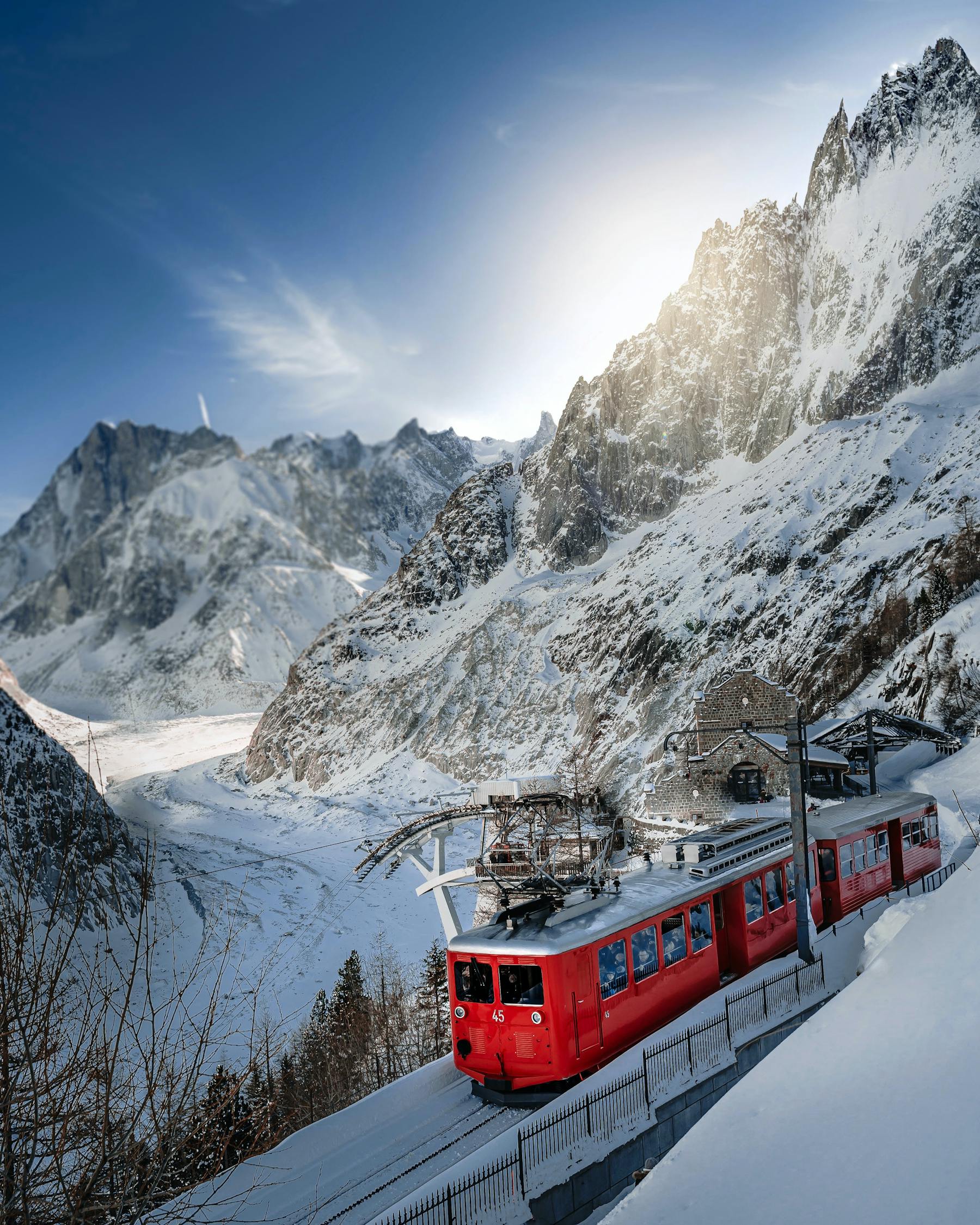
In a group of twelve, no two people ski at the same pace, and Chamonix makes that harder than most resorts: its ski areas are not linked to one another. So you stop planning the day everyone skis together, and start planning the moment everyone meets.
- Chamonix has a reputation for being bad for mixed-ability groups. That reputation is about the pistes, and it is fair. It says nothing about how a group can run its week.
- Splitting up in the morning is no problem here. Regrouping on skis is what breaks: the valley's four ski areas are not lift-linked to each other.
- That is where the answer sits: you meet by gondola, not on skis. A pedestrian pass opens the lifts on Brévent-Flégère and Balme without skis, plus the Aiguille du Midi and the Montenvers train, valley buses included.
- That pedestrian pass is €173 for six days, one rate for everyone aged 5 and over. It is what the non-skier spends, not what the skiers spend: their lift pass costs a good deal more. It covers neither Les Grands Montets nor Les Houches.
- Over six days' skiing, plan on two or three days skiing as a group. Push for more than that and everyone ends up worn down.
"Chamonix is no good for mixed-ability groups": what's true in that
The line comes up on forums and in resort guides, and it usually reaches a group before the first conversation about dates. Somebody has read that Chamonix is not a mixed ability resort. It is worth taking seriously, because three parts of it are simply true.
The first is the pistes. There is little easy terrain high up, the notable exception being the ground served by the Trappe chairlift above Flégère, and the reds are steeper than the average across the Alps.
The second is geography. The valley runs about thirty kilometres from Servoz to Vallorcine, and the ski areas are spread along the whole length of it rather than gathered round one village.
The third is the one that shapes everything else. There are four main ski areas: Brévent-Flégère above Chamonix, Les Praz and Les Bois, Les Grands Montets above Argentière, Balme at the far end between Le Tour and Vallorcine, and Les Houches at the opposite end.
None of the four is lift-linked to its neighbour. One of them, Brévent-Flégère, joins its own two sectors with a cable car called the Liaison. To get from one ski area to another, you come back down to the valley and take a bus, a train or the car.
What the criticism assumes is more debatable. It takes for granted that a successful trip is one where everyone skis together, when a group of twelve never skis together for long anyway, even on linked terrain where nothing stops it.
Why Chamonix reds feel steeper than the ones you know
Piste colours are set resort by resort, not to a national standard, so a red in one valley is not a red in the next. Chamonix grades tightly, and its reputation is earned: several of its reds would be marked black in resorts your group may know better.
This matters more for a mixed-ability group than for anyone else. The intermediate who is comfortable on reds at home may find the same colour here a step harder, which is worth knowing before you promise them a day out with the strong skiers.
The practical answer is not to talk your group up a grade. Pick the area by what it actually skis like, and let the colours be a rough guide rather than a promise.
What the ski holiday guides tell you, and what survives here
The ski holiday guides all give the same three-part method: pick a big linked ski area, split up in the morning by ability, meet at a mountain restaurant for lunch.
A linked area is not on offer here, and no amount of organising changes that. Splitting up in the morning, on the other hand, works well: it is not just possible in Chamonix, it is the norm, because each ability has its own sector.
That leaves lunch, and lunch is what people assume they lose along with the linked terrain. Meeting at midday does not depend on the pistes. It depends on there being somewhere everyone can reach.
Meeting up without skiing together
A mixed-ability group holds together on its meeting point.
A meeting point is somewhere anyone can reach whatever their level, at a time agreed the night before. It only has to be reachable by everyone, which is a far easier test to pass than being skiable by everyone.
In a linked resort, that place is a restaurant sitting where two pistes cross, and you arrive on skis. In Chamonix it is the top station of a lift, and you go up by gondola.
The difference matters, because a gondola does not care how well you ski. The one who spent the morning on a nursery slope, the one who never put skis on at all and the two who have been skiing blacks since the lifts opened all end up in the same place.
The pedestrian pass nobody mentions
The 100% pedestrian pass opens the lifts to anyone not on skis. It settles the meeting-point question on its own, and the mixed-ability guides still miss it.
Here is what it covers, and it is the only list worth remembering. On the ski areas: the Planpraz gondola and the Brévent cable car, the Flégère gondola, and the Charamillon and Vallorcine gondolas.
The Liaison is not included, so anyone on foot cannot cross from Brévent to Flégère high up. They have to choose which of the two to go up from the bottom.
That means two of the valley's four ski areas, Brévent-Flégère and Balme. Les Grands Montets and Les Houches are out.
Two things come with it that have nothing to do with skiing, and they matter most to whoever is not skiing: the Aiguille du Midi cable car and the Montenvers train up to the Mer de Glace. Valley buses are included too.
Alongside it, the ski pass the rest of the group will buy, the CHAMONIX Le Pass, covers three areas out of four, with Les Houches sold separately. An adult day runs from €59.20 early and late in the season to €74 in the school holiday weeks. Skiers who also want the Aiguille du Midi or the Italian side buy the MONT BLANC Unlimited instead, at a higher price. Nobody needs the same pass as the person next to them: which lift pass to buy, and for whom goes through the range profile by profile.
The 100% pedestrian pass is bought per person, for two days minimum, at €113, then €15 for each extra day: €173 for six days, €218 for nine. The rate is the same from age 5 to 100, with no child or senior reduction, and free under 5. Add €3 for the hands-free card that opens the gates.
Two days minimum means this pass suits someone who will not ski all week, rather than covering the odd day off. For a single trip up, each lift sells pedestrian return tickets at the ticket office on the day.
These are the rates from the last published price list, valid from 13 December 2025 to 3 May 2026. Check the one for your season before you buy.
Which leaves the question of how to spread six days' skiing across people who ski nothing like each other. You settle that once for the week, not every morning over breakfast.
Read next: Chamonix ski areas explained: which one to ski, and when
Plan the week, not the day
Over six days' skiing, trying to get everyone skiing together every morning does not survive three days. The strong skiers get bored, the beginners come back demoralised, and by Wednesday everyone agrees it was a bad idea.
The split that works is straightforward: two or three days as a group, the rest divided by ability. Group days are best spent on whichever ski area is closest to the house, because that morning journey happens every single day.
One caveat, worth checking before you book anywhere to stay: that rule only holds if the nearest area lets people up on foot. From Les Houches, meeting a non-skier for lunch means going back down the valley and up somewhere else.
| Who's in the group | Where their day happens | Why there |
|---|---|---|
| Has never skied | The nursery slopes on the valley floor, Le Savoy and Les Planards in Chamonix, then the easy ground served by the Trappe chairlift at the top of the Flégère gondola | The beginner pass covers all three, including the ride up to Flégère, at €27.50 a day against €59.20 and up for Le Pass |
| Comfortable on blues | Brévent-Flégère or Balme | Whichever of the two is closer to the house, since the journey repeats every morning |
| Skis well, wants long runs | Les Grands Montets, one or two days in the week | The slopes face north, so the snow holds up later in the season. The trade-off is driving further up the valley |
| Not skiing | Rides up to join the group at lunch, or spends the day at the Aiguille du Midi or on the Montenvers train | The pedestrian pass covers the lot, and doubles as a bus ticket into Chamonix |
Go through your own group line by line and one thing shows up quickly: nobody needs the same pass as the person next to them, and there is no reason to make a beginner pay for the pass the strong skiers need.
One thing shapes the whole week: people who have never skied do not simply get dropped on a nursery slope. They need lessons and a pass of their own, and at the valley ski schools morning slots in the school holidays go first, so those are booked early. Lessons, hire cars, airport transfers and who books what are all part of organising the trip itself, which is a job of its own when there are twelve of you.
Lunch: where the group can meet, and where it can't
Two of the four ski areas let people up on foot on the pedestrian pass, and that is what makes the meeting point work. The other two do not, and that settles what happens on one or two days of the week.
On Brévent-Flégère there is plenty of choice. Planpraz, the mid-station at 2,000 m, above Chamonix, has la Bergerie, Le Comptoir and the Brev'Bar right by the gondola.
Le Panoramic sits higher, at the top of the Brévent at 2,525 m. Across the way, the Foehn is at the top of the Flégère gondola, at 1,894 m.
On Balme, the pass opens the Charamillon gondola at Le Tour and the one at Vallorcine. The meeting point is then the top of either, where there is something to eat, so a group skiing that end of the valley is easy enough to join.
That leaves Les Grands Montets above Argentière, which is what the strong skiers will ask for, and Les Houches at the far end, whose runs through the trees are the answer to a day of flat light. Neither is on the pedestrian pass. On those two, lunch together does not happen.
One more thing, whichever area you are on: you do not walk into a mountain restaurant at half twelve and ask for a table for twelve. Book it the night before, when you tell everyone where you are meeting.
Last lift up and last lift down change every season and from one lift to the next. They set the time you meet, so check them area by area when you plan the week, particularly if your meeting point is the top of the Brévent, which takes two lifts from Chamonix.
Read next: Planning a ski trip with a large group: the organiser's guide
Evenings are where the house takes over
The mountain gives you one meeting point a day, and it lasts as long as lunch. The rest of the time the group is together, late afternoon and evening, is spent back at the house.
By then the number of rooms matters more than the number of beds. The ones who came back at two after half a day and the ones who stayed to the last lift are on different clocks, and there has to be enough space for nobody to notice.
That is why a chalet that sleeps fourteen is worth judging on its rooms as much as its beds. A cinema room, a spa, a gym and two dining tables that push together give a group of twelve somewhere to spread out, without anyone having to choose between sitting it out downstairs and going to bed.
Chalet Bonami is in Les Bois, 550 m from the Flégère gondola, a five-minute walk. The bottom station is what sits at the end of the road. The meeting point itself is at the top, at the Foehn restaurant. Skiers carry on to the Brévent side on the Liaison cable car without coming down. Pedestrians stay on Flégère, since the Liaison is not on their pass.
Three ways up in the morning: on foot with skis on your shoulder, by car, or on the hamlet shuttle for anyone who would rather not carry kit, bearing in mind it has to be booked ahead in winter. Coming back is the gondola and then the walk, as no piste runs down to the chalet. The concierge has ski kit delivered to the house, which saves the whole group a boot-fitting session in town on arrival day, and the ski room dries boots overnight.
Bonami's tip: line your Grands Montets day up with the day the non-skiers go to the Aiguille du Midi or take the Montenvers train. Since nobody can come up and join you for lunch there, let that be the day that belongs to the people who are not skiing, and both sites are already on their pedestrian pass. The group splits properly in the morning and comes back together at the house in the evening, everyone having done what they wanted rather than waited for someone else.
What those days actually hold, outing by outing, with how many people each one takes at once and what age it rules out, is covered in things to do in Chamonix for non-skiers.
Bonami is booked directly, with no agency in between: tell us your dates and we reply within 24 hours.
Chamonix mixed ability skiing: common questions
The questions that come up when a group has beginners and regulars in it.
Is Chamonix suitable for a mixed-ability group?
Yes, provided you give up on skiing together all day. There is little easy terrain high up and the ski areas are not linked, which makes the shared day hard work. Every ability does have terrain that suits it, though, and the pedestrian pass opens the lifts on two of the four areas, so the group still meets at lunch on days it has skied apart, Grands Montets and Les Houches days excepted.
Can a non-skier join the group up the mountain for lunch?
Yes, on a pedestrian pass, on Brévent-Flégère and on Balme. It opens the Planpraz gondola and the Brévent cable car, the Flégère gondola and the Charamillon and Vallorcine gondolas, and it includes valley buses. It only covers the ride up, not the meal, and it is bought per person for two days minimum.
How many days does a mixed-ability group actually ski together?
Two or three out of six days' skiing. Beyond that the best skiers spend the week riding the same easy runs over and over, and the least confident spend theirs trying to keep up. Those days are best kept on the ski area closest to the house: a whole group takes longer to get going than you'd think, and the morning journey repeats daily.
What happens on the day part of the group goes to Les Grands Montets?
The group splits for the whole day, with no lunch together. Neither Les Grands Montets nor Les Houches is on the pedestrian pass, which covers Brévent-Flégère and Balme. So line that day up with something the others actually wanted to do, the Aiguille du Midi or the Montenvers train for instance, rather than have it fall on a day that mattered.