
Planning a ski trip with a large group comes down to three decisions taken early and a dozen bookings made in the right order. The rest sorts itself out in resort, as long as somebody has said out loud who decides what.
- Planning a ski trip with a large group starts with three decisions: the week, a firm head count, and the budget bracket everyone accepts.
- Book the accommodation first. For Christmas, New Year and February half term, that means 8 to 12 months ahead.
- In Chamonix the four ski areas don't link up. Changing area means coming back down to the valley and taking a car, a bus or the train.
- Group rates on lift passes start at 20 people. A group of fourteen pays the individual rate.
What planning a ski trip with a large group really involves
It usually starts the same way. Somebody floats the idea over dinner, everyone says it sounds brilliant, and that person is still comparing listings on their own three months later.
The work isn't where you expect it. Booking a house takes an evening; getting a straight answer out of the other thirteen about a week in February takes six. Almost all of it happens before you travel, and the longest part is getting people to agree who want different things.
It's a refereeing job too. At fourteen, nobody gets exactly the holiday they pictured, and whoever organises has to decide on everyone else's behalf without having to defend it all winter.
The markers below apply to groups of eight or more. At twelve or fourteen, they stop being markers and become constraints.
The three decisions that block everything else
The week comes first, because it sets both the price and what's still available. Pick one, with a fallback, rather than circulating three dates in a group chat: houses that sleep twelve to fourteen are gone before the group has finished voting.
Then the head count, and it has to be firm. Not "we'll be twelve or fourteen", but how many adults, how many children and how old. The number of adults dictates the number of bedrooms, and that figure decides whether a house works, not the one in the listing.
The budget, at least as a bracket, gets discussed before anyone looks at listings. Otherwise the group loses a month viewing houses that half of them find too expensive.
The school calendar decides the week, and not only your own. UK half term falls in the middle of the four-week window over which French school holidays are staggered across three zones, so the same week carries British and French demand at once.
If your group mixes nationalities, or English counties with different term dates, check both calendars before fixing anything. The dates move every year.
Read next: What a week in a luxury chalet in Chamonix costs
Splitting the roles: nobody organises a group ski trip for fourteen alone
Group trips rarely fall apart over a big decision. They fall apart over the small ones nobody made, because everybody assumed somebody else had.
Four roles are enough, and they get handed out as soon as the week is fixed. Each person needs to know what they settle on their own, without consulting the other thirteen. Nothing more formal than that.
| Role | What they settle alone | What they don't |
|---|---|---|
| The coordinator | The week, the house, travel, who's coming | The daily programme |
| The ski lead | Lift passes, lessons, equipment hire, guiding | Who skis with whom each day |
| The housekeeping lead | The arrival shop, who cooks when, restaurant tables, the private chef | The budget for activities |
| The non-ski lead | Children's lessons, what the non-skiers do, childcare | What the adults who sort themselves out do |
That fourth role is the one nobody thinks to create, and the one that's missed most. In a group of fourteen there are almost always two or three people who don't ski, or don't ski every day, and without someone looking after them they end up following everyone else's rhythm and are never asked what they'd like to do.
Bonami's tip: set a reply deadline and decide without the people who haven't answered. Every group of fourteen has two or three who reply the day after the last suitable house has gone, and waiting for them costs the group more than deciding without them.
What a tour operator does for you, and what you take on
Most British groups are used to the package: flights, transfer, chalet, staff and lift passes arrive as one line on an invoice, and one company carries the coordination. Booking a chalet directly changes the deal. You get the whole house to yourselves, you choose your own arrival day, and you pick up the coordination the operator used to absorb.
That's not an argument against either model, but it does change the job. Passport details, dietary requirements and a transfer that needs moving when a flight slips all land on the coordinator. What you gain is a house with no one else in it and a single point of contact who knows the property.
The other shift is on catering. The catered chalet model has receded in Chamonix over the past few years, so a chef is now something you book for the evenings you want rather than something that comes with the house.
Read next: Booking a chalet direct with the owner: what to check first
Chamonix: four ski areas that don't link up
Chamonix-Mont-Blanc isn't a purpose-built resort arranged around a single lift base. The valley strings its villages along thirty kilometres (nearly twenty miles) and has four separate ski areas: Les Houches-Saint-Gervais to the south, Brévent-Flégère above Chamonix and Les Praz, the Grands Montets at Argentière, and Balme between Le Tour and Vallorcine.
None of the four connects to its neighbours. The only lift that takes you from one sector to another without descending links the Brévent to the Flégère, the two halves of a single area. Everywhere else, changing area means coming back down, taking the car, the bus or the train, and going up the other side.
If your group has skied the Trois Vallées or the Portes du Soleil, this is the difference that catches people out. The area gets chosen the night before for everybody, which our comparison of the ski areas is there to settle, and you need vehicles, three of them for fourteen people with kit, or a working knowledge of the valley bus routes.
Chalet Bonami sits in Les Bois, 550 m from the Flégère gondola and 3 km (2 miles) from the centre of Chamonix. You reach the lift on foot with skis over your shoulder, by shuttle or by car. Bus route 2, which runs the length of the valley from Le Tour down to Les Bossons, serves the hamlet and reaches the Grands Montets without a car.
Read next: Where to stay in Chamonix: choosing the right village
The booking order for a group ski trip, twelve months out to departure
Bookings aren't equal. Some are decided a year ahead, others the week before, and treating them the same wastes the ones that matter.
| When | What gets booked | Who does it |
|---|---|---|
| 12 to 8 months out | The house, for February, Christmas and New Year | The coordinator |
| As soon as the house is confirmed | Flights and trains, hire cars | The coordinator |
| 2 to 3 months out | Ski lessons and mountain guiding | The ski lead |
| 2 to 3 months out | The private chef | The housekeeping lead |
| The month before | Lift passes and equipment hire | The ski lead |
| The month before | Restaurant tables | The housekeeping lead |
| The week before | The supermarket delivery, the list of missing kit | The housekeeping lead |
| The night before | Tomorrow's ski area | Everyone, around the table |
The house first, everything else after
Nothing gets booked before the accommodation. Houses that sleep fourteen are rare in any valley, and they're the first to go.
The number in the listing deserves one more question. A house advertised for fourteen often sleeps ten adults in bedrooms and four children in bunks. That's the case at Bonami, where the ten-adult layout is the one where nobody is in a bunk bed.
One practical point changes a lot for a group: the arrival day, which is negotiated when you book the house rather than afterwards. A week that has to start on a Saturday forces fourteen people to line up their leave and their flights on the same slot. When that day is flexible, as it is at Bonami for a stay of three nights or more, the group works around the flights instead of the other way round.
Two lift passes cover the valley. CHAMONIX Le Pass covers the Chamonix ski areas without the top of the Grands Montets. MONT BLANC Unlimited adds Les Houches-Saint-Gervais, the high-altitude sites such as the Aiguille du Midi and Montenvers, and ski areas in Italy and Switzerland.
- Reduced rates for ages 5 to 14 and 65 to 79, free for under-5s on proof of age.
- A family rate from two adults and two young people, with up to three more children aged 5 to 14. The exact age brackets are on the official grid.
- Group rates start at 20 people and are handled by a separate service for companies and clubs. A group of fourteen buys at the individual rate.
- Prices vary by period within the season, and season passes are sold at the ticket office only.
Checked in August 2026 against the previous season's grid. The following winter's prices are published in the autumn, so check the current grid before you fix a budget.
Bonami is booked directly, with one point of contact from the first email to the keys: tell us your dates and we reply within 24 hours.
Getting fourteen people to the valley
Geneva is the nearest airport, a little over an hour away, and it's where most of the group will land. Flights rarely arrive together, which is why a single arrival time matters more than a single mode of transport.
Three options cover almost every group: a private minibus transfer booked once for the whole party, usually priced per vehicle rather than per seat; hire cars, which let you change ski area during the week; or the train, which reaches the valley either from Saint-Gervais on the French side or from Martigny in Switzerland, stopping in most villages.
Most groups end up mixing them: cars for the people who want to move around, a transfer for whoever lands late. However you split it, the number of cars is a booking decision rather than an in-resort one. Hire cars run out in February, and three is the safe figure for fourteen people with kit, whichever ski area you end up choosing each morning.
In Haute-Savoie, winter equipment is compulsory across the whole department from 1 November to 31 March: either four winter tyres, or chains or snow socks carried in the vehicle. The rule covers cars, vans and coaches.
A hire car picked up in Geneva is not automatically fitted for France. Ask when you book the vehicle, not at the desk. Checked in August 2026, worth confirming before each winter.
Mixed abilities, children and non-skiers
A group of fourteen never has one ability level. It has two or three beginners, a majority of solid intermediates, one or two who want to get off-piste, and often someone who won't ski at all.
This is the part that gets prepared least, and it's the part that decides the mood by Thursday. A beginner who has spent the week trailing confident skiers is unlikely to ask to come again. How a mixed-ability group splits up its days is a separate job, once the bookings are out of the way.
Lessons and guiding get booked early
Count who needs what before booking a single lesson, bearing in mind that complete beginners don't book like everyone else: different slot, different place, different lift pass. The ski schools run group lessons for adults as well as children, private lessons for anyone who would rather not be in a class, and mountain guides for those aiming off-piste or at the Vallée Blanche, the glacier route down from the Aiguille du Midi that you ski with a guide.
Both the Chamonix ski school and the Compagnie des Guides take bookings online. Morning slots go first during the school holidays, and a private lesson for four adults is harder to place than a children's group class.
What the people who don't ski actually do
The high-altitude sites work without skis. The Aiguille du Midi cable car, which climbs to a viewing platform facing Mont Blanc, and the Montenvers railway, which runs up to the Mer de Glace glacier, are both included in the MONT BLANC Unlimited pass and can be bought as day tickets by someone who doesn't need a pass all week.
The valley also has an ice rink and an aquatic centre with indoor and outdoor pools. There is more to a week here than the pistes, which is what makes it workable for a group where not everyone skis.
Then there's the morning question: how the non-skiers get around once the cars have left with the skiers. The train and the buses run the length of the valley, so two people can go down into town or up to a viewpoint without depending on anyone. Worth checking before you book the house, because not every village is equally well served. What the group actually does with those days, outing by outing, with group sizes and booking times, is covered in things to do in Chamonix for non-skiers.
Read next: Inside Chalet Bonami, room by room
The week itself: what gets decided the night before, and what the house takes care of
A group of fourteen doesn't run to a programme set three months earlier. The weather, the snow and how tired everyone is by Wednesday make better decisions than any shared spreadsheet.
Three things get settled the night before, around the table: tomorrow's ski area, what time the cars leave, and who eats where.
The departure time of the cars is the only time that matters. Breakfast for fourteen stretches over two hours, and trying to get everyone up at once produces nothing but irritation. Announce when the cars leave and let people organise themselves around it.
Lunch is worth sorting the night before too. A mountain restaurant will take a table of fourteen if it's warned, rarely if it discovers the group at half twelve, and plenty of families would rather come back down to the house when it's close to a lift.
Bonami's tip: don't plan to ski on arrival day. Between collecting equipment for fourteen people, sorting lift passes and the first food shop, half the group won't be ready before midday. Allow half a day to settle in, and the real first day of skiing starts the next morning.
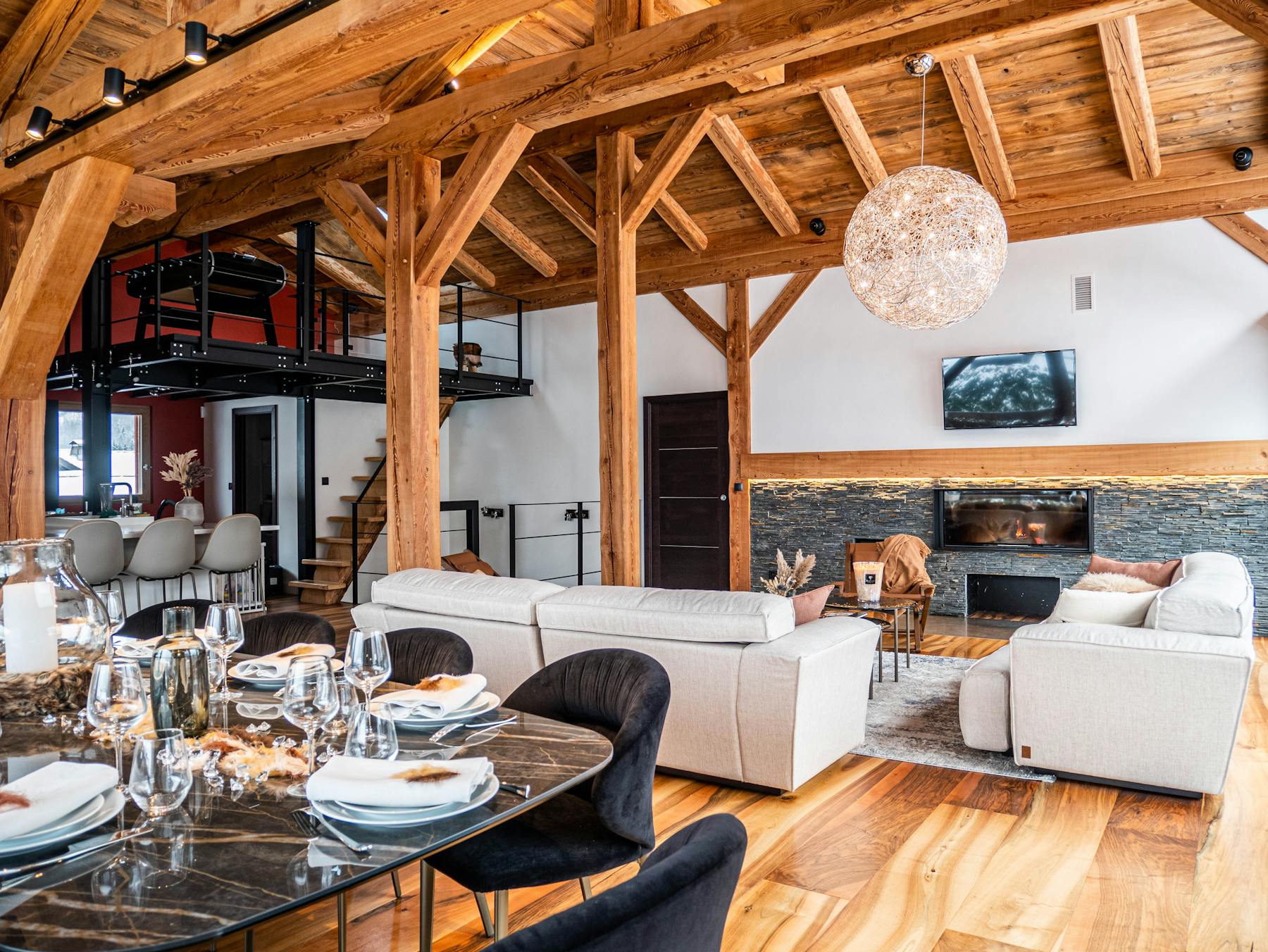
In the evening the house becomes the meeting point again, and that's where the number of rooms matters more than the number of beds. With several to spread into, the people watching a film, the people in the spa and the people cooking dinner aren't in each other's way.
Then there's the housekeeping, which adds up more than you'd expect at fourteen. At Bonami, the end-of-stay clean, bed and bath linen and the tourist tax are included in the week, and the concierge handles what comes up during the stay, from a private chef to a supermarket delivery.
Frequently asked questions about organising a group ski trip
These are the questions that come up most often when a group gets in touch.
How do you coordinate fourteen arrivals?
Fix a meeting time rather than a shared mode of transport. Groups rarely travel together: some drive, some land at Geneva at different hours, and one or two take the train. Accommodation with a flexible arrival day, as at Bonami for stays of three nights or more, saves you lining up fourteen sets of annual leave on the same Saturday.
What happens if someone drops out after you've booked?
The group absorbs their share, unless they've taken out cancellation cover of their own. A holiday let is rented as a whole property: the price doesn't drop because one person pulls out. Agree what happens in that case at the start, and check what the rental contract says before anyone pays a deposit.
Does everyone in the group need the same lift pass?
No, and it's rarely the best choice. People skiing the valley areas every day don't need what someone going up the Aiguille du Midi or spending a day in Italy needs. Children under 5 ski free, and the family rate applies from two adults and two young people.
Is there a group discount on Chamonix lift passes?
Only from 20 people, and only through the service that handles companies and clubs. Below that threshold a group buys at the individual rate whatever its size. What remains are the age-based reductions and the family rate, which apply person by person.
Do you need to hire cars for a group of fourteen?
Three cars, in practice, to move fourteen people and their equipment. Two are enough if the group skis the area closest to the house and takes the bus or train to the others. The valley has three year-round bus routes running its full length, plus the train from Servoz to Vallorcine, which is free with the guest card, the pass your host hands you on arrival, one per person for the length of the stay.