
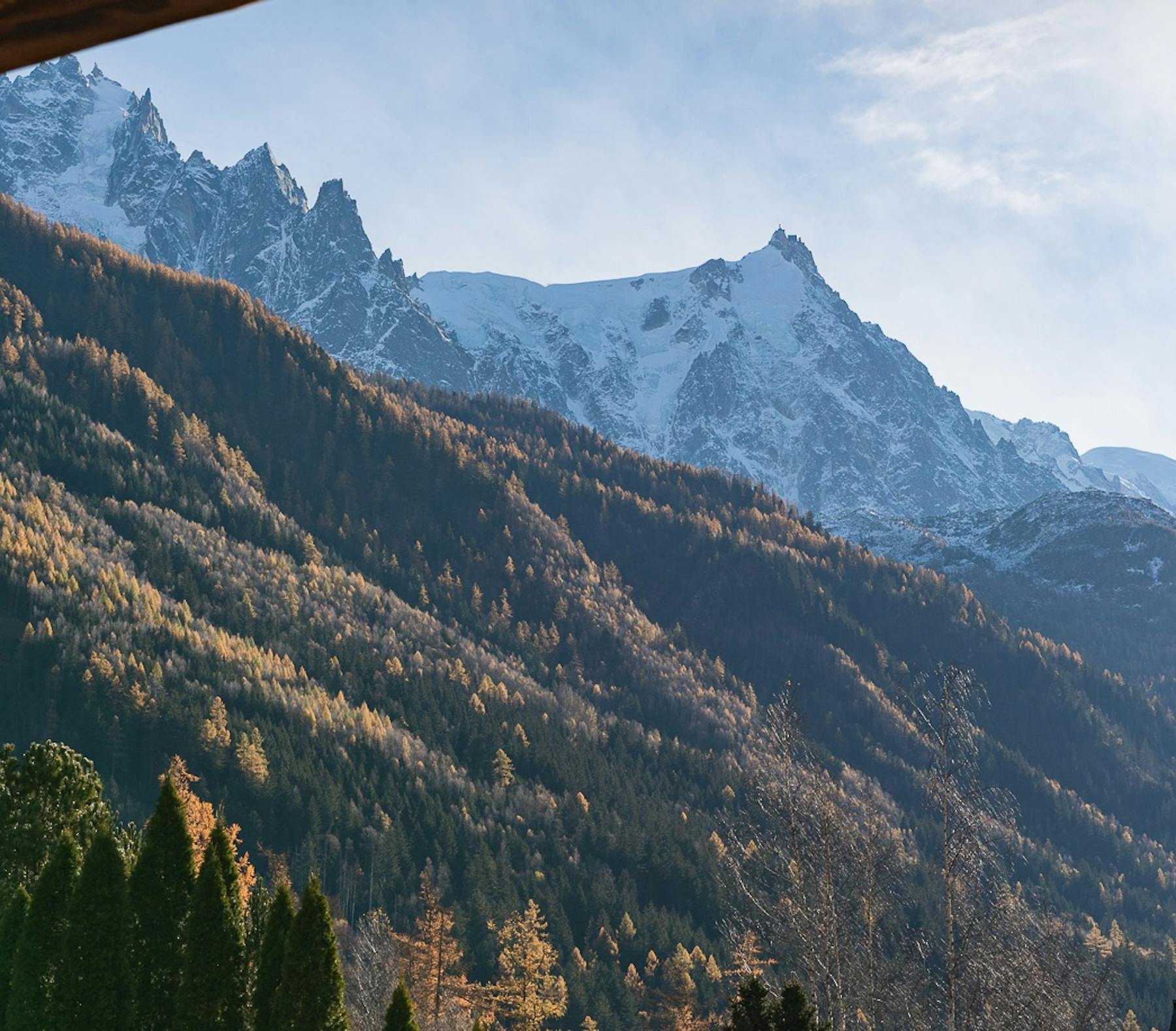
The village you sleep in decides which ski area you look at every morning. Chamonix's four ski areas are not linked to each other, and over a week that matters far more than a couple of kilometres more or less to the town centre.
- Deciding where to stay in Chamonix means choosing a ski area first: the valley's four domains do not connect. In summer what matters flips to trailheads and train stops.
- The valley runs about thirty kilometres (19 miles) and climbs from 815 m at Servoz to 1,460 m at Le Tour. From the centre, Les Praz is 2.6 km, Argentière 9 km, Vallorcine 16 km.
- The valley train is free between Servoz and Vallorcine with the Guest Card. The buses are not: budget about €10 a week for each person who does not hold a lift pass.
- Houses that sleep twelve to fourteen are not in the town centre. They sit in the villages and hamlets, from Les Houches up to Argentière.
What to know about the valley before you pick an area
Chamonix was never purpose-built around a single lift base. It is a valley of villages and hamlets strung along the river Arve and the railway line, which rental listings call areas or neighbourhoods more or less interchangeably. You are not picking a spot in a resort here; you are picking a village.
Two mountain walls frame it and they behave differently. To the north-west, the Aiguilles Rouges: lower, south-facing, home to Le Brévent and La Flégère. To the south-east, the Mont Blanc massif, its glaciers and its big cable cars, with Les Grands Montets and the Aiguille du Midi.
Four ski areas, one link between them
The valley has four alpine ski areas. From south to north: Les Houches-Saint-Gervais, Brévent-Flégère above Chamonix and Les Praz, Les Grands Montets at Argentière, and Balme between Le Tour and Vallorcine.
None of them connects to its neighbour. The only lift that takes you from one sector to another without going back down is the Brévent-Flégère link, which runs along the ridge and makes those two sectors halves of a single area. Everywhere else, changing area means dropping back into the valley, taking the car or the train, and going up again.
This is what sets Chamonix apart from the Three Valleys or Val d'Isère and Tignes, and it is the thing British groups underestimate when they book. Over seven days, a group ends up skiing where it sleeps, whatever it intended. Once you have picked the village, you still have to pick the mountain: our comparison of the four ski areas sets out their altitudes, aspect and who each one suits.
The Mont Blanc Unlimited pass covers all four areas and the high-mountain sites, and a cheaper valley pass covers the ski areas without the Aiguille du Midi. Neither shortens the drive.
In summer, what matters flips
What separates the areas in winter is the pistes. On foot, the valley stitches itself back together: the balcony paths, the trails that follow the mountainside at a constant height, run the length of the Aiguilles Rouges, and the valley train brings you back in the evening. A summer walk is happily done one way only.
So the question changes in July and August. What counts then is a trailhead at the door and a train stop for the return leg, plus a lift you can reach without a car when you want height early. The Tour du Mont Blanc starts at Les Houches, La Flégère and Le Brévent open the south-facing side, Le Tour and Vallorcine command the top of the valley.
One practical point: trailhead car parks fill before 9 am in July and August. Staying within walking distance of a lift beats adding five kilometres of driving to the day. In the last week of August the priorities change again, and where to stay for UTMB comes down to shuttles and getting back at night.
Sun, altitude and snow
The valley floor is deep and narrow. In December and January the sun comes up late behind the ridges and drops early, and the difference from one village to the next is bigger than it looks on a map.
The pistes on La Flégère and Le Brévent face due south: light all day, and snow that softens by mid-morning in spring. Facing them, on the Mont Blanc side, Les Grands Montets go higher and hold their snow longer, at the price of the cold.
Village altitude does the same work. Between Servoz at 815 m and Le Tour at 1,460 m there are more than six hundred metres of height and often several weeks of snow cover.
The valley train and the buses
The Mont-Blanc Express, the valley train, runs from Saint-Gervais to Vallorcine and on into Switzerland, stopping at nearly every village. Roughly one train an hour, with a half-hourly service on summer afternoons. The train stop column in the areas table gives the stop for each one.
The Guest Card is the pass your host hands you on arrival, one per person, valid for the stay. It makes the line free between Servoz and Vallorcine, which is what makes an outlying village workable without a car. Check the time of the last train before you book a table for fourteen in town.
Three bus routes run all year: number 1 between Les Houches and Les Praz-Flégère, number 2 between Le Tour and Les Bossons via Argentière, Le Lavancher, Les Tines and Les Bois, number 3 from Servoz. Night services, the Chamo'Nuit routes, take over in the evening.
The Guest Card rules have changed, and the change matters when there are fourteen of you.
- The train stays free between Servoz and Vallorcine on production of the card.
- The buses no longer are: the card is not a ticket; it entitles you to a reduced fare of about €10 per person for the week instead of €18.
- Tickets are bought in advance, online or at a machine, not from the driver.
- A lift pass or a Multipass, the valley's walker and leisure pass, does count as a bus ticket.
- Reduced fares do not apply on night buses.
Checked on the tourist office website in August 2026; worth checking again before each season.
Chamonix areas at a glance
The table reads south to north, the order you drive up the valley from Geneva. The lifts named are the base stations, not the summits.
| Area | Altitude | From the centre | Nearest lift | Train stop |
|---|---|---|---|---|
| Servoz | 815 m | 14 km, 15 min | None. Les Houches 6 km away | Servoz |
| Les Houches | 1,000 m | 8 km, 10 min | Bellevue cable car and Prarion gondola, in the village | Les Houches |
| Les Bossons, Les Pèlerins | 1,020 m | 2.4 to 3.8 km, 4 to 7 min | Planpraz in town. Les Houches 5 km away | Les Bossons, Les Pèlerins |
| Chamonix centre | 1,035 m | town centre | Planpraz gondola up to Le Brévent, plus Les Planards and Le Savoy for beginners | Chamonix |
| Les Praz | 1,060 m | 2.6 km, 4 min | Flégère gondola, in the village | Les Praz |
| Les Bois, Les Tines | 1,090 m | 3 to 4.5 km, 5 to 7 min | Flégère gondola, between Les Praz and Les Bois | Les Praz, Les Tines |
| Le Lavancher | 1,200 m | 6 km, 9 min | Flégère 3.5 km, Grands Montets 3 km | Les Tines, La Joux |
| Argentière | 1,252 m | 9 km, 13 min | Grands Montets gondola, in the village | Argentière |
| Le Tour | 1,460 m | 12 km, 16 min | Charamillon gondola, up to Balme | Montroc-le-Planet |
| Vallorcine | 1,260 m | 16 km, 20 min | Vallorcine gondola, up to Balme | Vallorcine |
Distances are road distances from the church square in central Chamonix, and the times assume clear roads. On a Saturday in February, changeover day for the whole valley, or around 5 pm when the lifts close, double the figure between Argentière and town.
Getting there from Geneva
Nearly every group flying in lands at Geneva, an hour and a quarter from central Chamonix by road. Add fifteen minutes for Argentière and twenty for Vallorcine; take a little off for Les Houches. On a February Saturday, allow considerably more: that is the day the whole valley arrives and leaves at once.
Two practical points for a group of fourteen. A standard transfer van seats eight, so you need two vehicles, and they should be booked together rather than separately. And if you hire cars instead, French law requires winter tyres or a set of chains from 1 November to 31 March across the whole of Haute-Savoie, Chamonix valley included, and rental agreements at Geneva do not always include them by default.
Read also: What a week in a luxury Chamonix chalet costs
What changes when there are twelve or fourteen of you
For two people, all these villages work: you take the train, eat where you like, walk home. At twelve or fourteen, a few hard practical limits kick in, and they are what rule whole areas out.
Where the large houses actually are
Not in the centre. The centre is flats, hotels and purpose-built apartment blocks, with a handful of houses. Whole properties this size are rare there, and rarely quiet. The large chalets sit in the villages and hamlets between Les Houches and Argentière: Les Houches, Les Bossons, Les Praz, Les Bois, Les Tines, Le Lavancher and Argentière.
Those are also the places with land around the house and room to park, which counts when fourteen people share a roof for a week.
One word of warning on vocabulary: in Chamonix, "chalet" rarely means staff living in. Most large houses in the valley are let empty, with a chef booked separately for the evenings you want one.
Read also: Catered vs self-catered chalets in Chamonix
Parking, food shopping and the days nobody skis
A group of fourteen rarely arrives in one car: reckon on two or three, or on two transfer vans from Geneva, since a van seats eight. In town, parking is paid and scarce; in the hamlets, it comes with the house.
Then there is feeding everyone. A week's shopping for fourteen means a supermarket run, and the valley's two largest are at Chamonix Sud, on the southern edge of town, and at Les Houches. From Argentière or Vallorcine that is an expedition rather than a quick run.
And there is the part nobody plans for: in a group of fourteen, not everyone skis, and nobody skis every day. You want a village where a day off the slopes exists, with a shop, a walkable path and something for children or grandparents.
Bonami's tip: worry less about the distance to the lifts and more about what you can do on foot from the house. Over a week at fourteen, the tiredness rarely comes from the run to the lift station. It comes from the car journeys that one adult ends up doing for everybody else. When a path, a bus stop and a lift are reachable without car keys, the rhythm of the group genuinely changes.
Servoz, Les Houches, Les Bossons and Les Pèlerins: the valley entrance
This is the first stretch you drive through coming from Geneva, and the cheapest. Les Houches is a separate commune, not part of Chamonix, with its own forested ski area, shops and station, eight kilometres (5 miles) from the town centre.
The Les Houches ski area is the gentlest in the valley: moderate gradients, wide pistes and trees to ski among when the light goes flat. There is a beginners' area at the top of the Bellevue cable car rather than in the village, so the very first lessons are usually taken down in the valley. It is good terrain for children who are progressing, and the area the strong skiers in the group will like least, a disagreement better settled before booking than on day three.
Les Bossons and Les Pèlerins sit in between, under four kilometres from town. You get detached houses, the Bossons glacier overhead and a position halfway between Le Brévent and the Les Houches ski area. The drawback is shade: hemmed in under the Mont Blanc side, these hamlets are among the least sunny in the valley in midwinter.
Servoz, finally, is a farming village on a terrace at the mouth of the valley, 200 m lower than Chamonix and fifteen minutes' drive away. Prices are the lowest of the sector, but it has no lift of its own and every day starts with a drive.
Chamonix centre: everything on foot, and what you give up
Staying in central Chamonix means doing without a car for everything that is not skiing. Restaurants, the Saturday market, the ice rink, the swimming pool, the bus station and the Planpraz gondola all sit within a ten-minute walk. If your group plans to eat out several evenings, nothing else in the valley comes close.
The two easiest beginners' areas are here as well: Les Planards, the largest in the valley, and Le Savoy, both a short walk from the centre. A family whose children are taking their first lessons should weigh that, because the high ski areas are not learning terrain.
The comfort has a price. Rates are the highest in the valley, parking is a permanent problem in February and August, and the end-of-day noise carries to the windows.
On the skiing side, the Planpraz gondola climbs from town towards Le Brévent, and the Brévent-Flégère link then crosses to the second sector along the ridge. Access is good; it just takes one lift more than from Les Praz.
Les Praz, Les Bois and Les Tines: at the foot of La Flégère
Less than three kilometres north of town the valley opens out and the pace changes. Les Praz keeps a church, a golf course and a few shops around the Flégère gondola, which leaves from the village. Les Bois and Les Tines continue the sector as hamlets between meadow and forest, facing Les Drus and the Aiguille Verte.
This is the compromise most groups end up looking for: direct access to Brévent-Flégère, the town five minutes away by car or one stop by train, and the quiet of a hamlet with no through traffic. Large houses are more common here than anywhere else, with land and parking spaces.
The sector has its limits, and they are worth knowing. The shops at Les Praz cover daily needs, not a week's shopping for fourteen, and an evening in town ends with a train or a car.
Higher up, Le Lavancher is a hamlet perched away from the road at 1,200 m, with no shop and three kilometres from the nearest lift. Nobody passes through, and nothing gets done there without a car.
Chalet Bonami is in Les Bois, 550 m from the Flégère gondola and 3 km from central Chamonix, five to six minutes by road. Geneva Airport is about an hour and a quarter away. A group skiing Brévent-Flégère can leave the cars at the chalet all week; for the other areas, Les Praz, 400 m away, is the nearest train stop and bus route 2 serves the Les Bois stop.
Read also: Les Bois and the Chamonix valley, seen from the chalet
If your group is after a whole house in this sector, Chalet Bonami is let direct by its owners: tell us your dates and we answer within 24 hours.
Argentière, Le Tour and Vallorcine: the top of the valley
Argentière is the last full village in the valley, nine kilometres from town and two hundred metres higher, at 1,252 m. It has shops, bars, a ski school, and the Grands Montets gondola leaves from the village. It is the choice of skiers who come for the most demanding terrain in the massif: steep slopes, few easy pistes, a great deal of off-piste.
What the skiing gains, the logistics take back. Every trip into town becomes a thirteen-minute drive, the shopping is done in Chamonix, and the village runs at half speed outside the two seasons. In November or May, some of the shops are shut.
Higher still, Le Tour is the highest village in the valley at 1,460 m, with Montroc-le-Planet just below it on the road and the sector's train stop. The Balme area above is sunny and builds up gently, with the Vormaine beginners' area at the foot of the lifts, which suits families skiing together. There are, on the other hand, almost no large houses to rent up there.
Vallorcine, on the far side of the Col des Montets, is the quietest place in the valley. Allow twenty minutes' drive to Chamonix over a pass that occasionally closes in heavy snow, though the train keeps running when the road is shut.
Which area for which trip
No village wins on every count. The simplest method is to name one priority for the group and let everything else arrange itself around it.
| Your priority | The sector that fits | Why |
|---|---|---|
| Skiing every day, strong skiers | Argentière | Grands Montets in the village, the most technical terrain in the valley |
| Skiing every day without giving up the town | Les Praz, Les Bois, Les Tines | Brévent-Flégère at the door, the centre five minutes away |
| Children learning to ski | Chamonix centre, Le Tour | Les Planards and Le Savoy on foot from town, La Vormaine at the foot of the Le Tour lifts. At Les Houches the beginners' area is at the top of the cable car |
| Eating out without driving back | Chamonix centre | Everything on foot |
| Walking from the house | Les Praz, Les Bois, Les Tines | Trailheads at the door, La Flégère under a kilometre away, access to Lac Blanc and the Mer de Glace |
| Walking the Tour du Mont Blanc | Les Houches, Le Tour, Vallorcine | All three on the route itself and served by the train, so you can walk one way |
| Quiet above all | Le Lavancher, Vallorcine | Hamlets off the main road |
| A tight budget | Les Houches, Servoz | The lowest rates in the valley, provided you accept the distance and budget for a car |
That table is about the trip, not about capacity: Servoz, Le Tour and Vallorcine have very few large houses, and looking for one there at fourteen usually means splitting the group across two properties.
For a group of twelve to fourteen who want a single house, the choice narrows in practice to three sectors: Les Praz-Les Bois-Les Tines, Argentière and Les Houches. They are the only ones that combine all three conditions: houses of that size in any number, parking on the plot, and a ski area in the village. That last condition is what rules out Les Bossons, Les Tines and Le Lavancher, where you drive to ski.
Once the village is settled, the house itself is still to choose, and the number on a listing never tells you how many adults it sleeps.
Read also: Booking a chalet direct with the owner, or through a tour operator
Common questions about where to stay in Chamonix
These are the questions that come up in almost every group enquiry.
Which part of Chamonix should we stay in?
There is no single answer, because it depends on what you have come to do. In winter it depends on the ski area you want at the door: Les Praz and Les Bois give the most direct access to Brévent-Flégère while keeping town five minutes away, Argentière wins if skiing outranks everything else, Chamonix centre and Les Houches if the group includes children learning. In summer what matters is the trailhead and the train stop.
Is it better to stay in Les Houches or Chamonix?
Les Houches suits groups with young children and tighter budgets: the ski area is gentler, rates are lower, the village is self-sufficient. Chamonix suits people who want to do everything on foot and go out in the evening. The eight kilometres between them are covered by train or bus, but they separate two ski areas that do not connect.
Can a group of twelve or fourteen manage without a car?
Yes for the days, less easily for the logistics. The Mont-Blanc Express is free with the guest card between Servoz and Vallorcine, it stops at nearly every village, and three bus routes fill the gaps for the price of a ticket. The two limits are the time of the last train in the evening and the week's food shopping, which needs a boot at fourteen.
What is the difference between Les Praz and Les Bois?
Les Praz is a village with a church, a golf course, a few shops and the valley station of the Flégère gondola. Les Bois is the neighbouring hamlet, a few hundred metres further on, with no shop, between meadow and forest. You get more detached houses and less passing traffic, for the same access to La Flégère.
Which area works for a walking holiday?
Les Praz, Les Bois and Les Tines to set off on foot from the house and reach La Flégère without a car. Les Houches, Le Tour and Vallorcine for a trip built around the Tour du Mont Blanc, whose route passes through all three. In every case the train stop counts as much as the lift: it lets you walk one way and come back along the valley floor.
When should we book for February half term?
The February weeks are the busiest of the season in Chamonix, since French school holidays and British half term overlap, and large houses go eight to twelve months ahead. If your dates are fixed by school terms, the sector ends up decided by what is still available rather than by preference, which is another argument for settling on two or three acceptable areas early.