
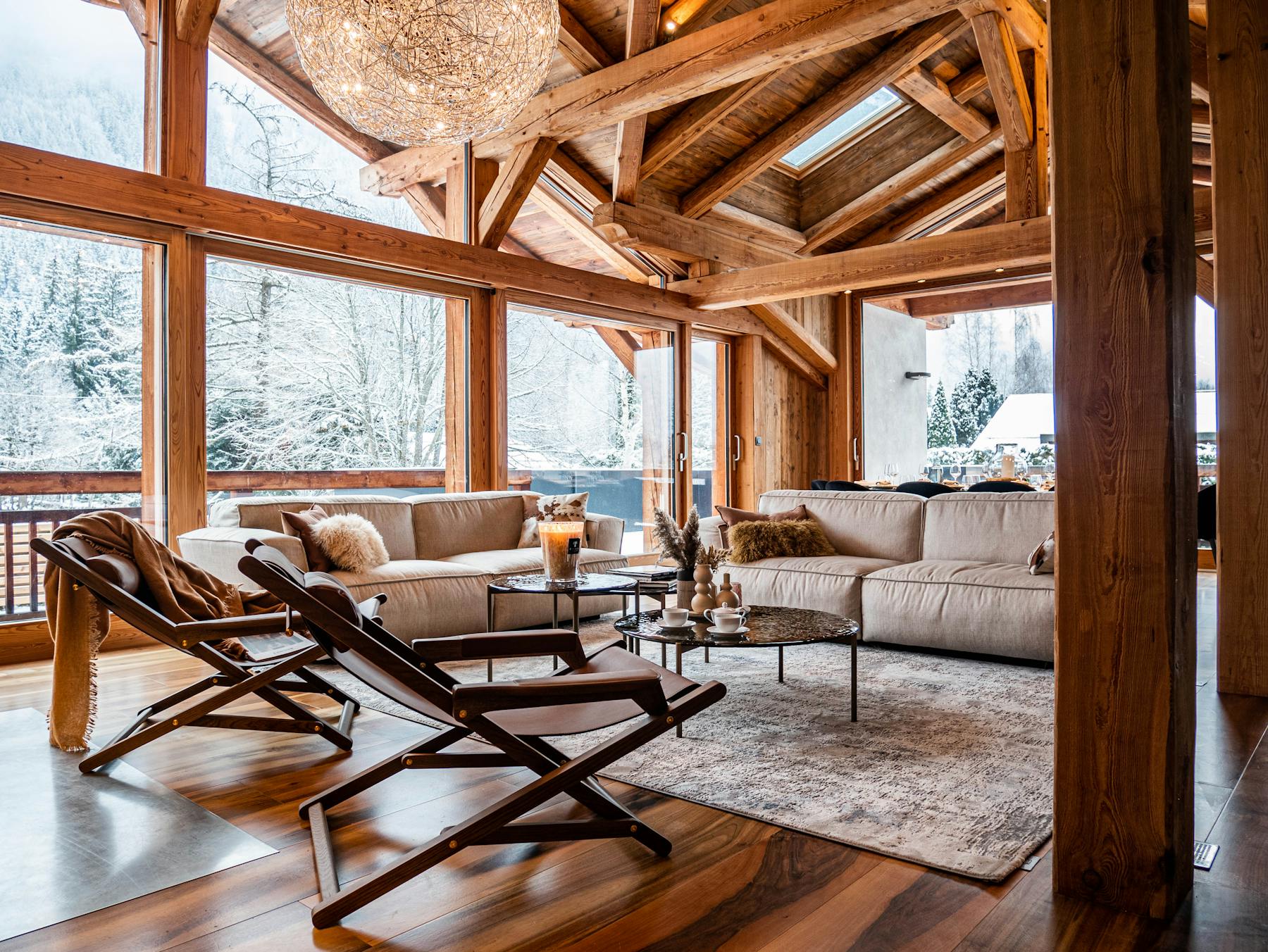
In Chamonix the choice is rarely between a catered chalet and a self-catered one. Most large chalets here are let as whole houses with no staff living in, and the cooking is bought separately, one evening at a time.
Groups used to booking in the UK expect the opposite, which is why the question reaches us in nearly every enquiry for 12 people or more.
- A catered chalet comes with a chef and a chalet host, the person who serves, tidies and keeps the week running. A self-catered chalet is the house on its own.
- Catered weeks are priced per person and often sold by the room. Self-catered houses are priced per property. The two figures do not measure the same thing.
- Most large chalets in Chamonix are let self-catered, and what a group of 14 usually ends up with is part-catered: the whole house to yourselves, plus a private chef on two or three evenings.
- Chalet Bonami sleeps 14 across five double bedrooms and a bunk room, and is let as a whole house. The end-of-stay clean comes with the weekly rate; a chef, a driver and daily housekeeping are booked separately.
Catered, self-catered and by the room: what the words mean
Three words do most of the work in a chalet listing, and they tell you how the week is sold, not how good the house is. A fourth arrangement, part-catered, has no standard label and is what a lot of groups end up booking.
| Option | Who cooks | Who else is in the house | How it is priced | Who cleans |
|---|---|---|---|---|
| Catered | The operator's chef and host | Often other guests, a room each | Per person, per week | Staff, daily |
| Catered, sole occupancy (your group takes every room) | The same team | Your group only | Per person, with a minimum party size or a surcharge for empty beds | Staff, daily |
| Self-catered | You | Your group only | Per property, per week | Whatever the rate includes, then you |
| Part-catered | A chef you book for chosen evenings | Your group only | The property, then each service you add | Whatever the rate includes, then you |
A catered week is quoted per person. A self-catered house is quoted for the whole property. Comparing the two figures directly tells you very little, and for a house this size the week you choose moves the total far more than the service does.
What a catered week actually includes
A catered week is sold on what the trade calls chalet board: breakfast, afternoon tea (a cooked spread when everyone comes off the mountain, not a cup of tea) and a three-course dinner with wine. Not every evening, though. Operators serve dinner on five or six nights out of seven and keep the rest as staff nights off, when breakfast is usually laid out cold and dinner is yours to sort out.
Check that line in the small print before you assume the week is handled. On the two-nights-off version, more than a quarter of your dinners are not included.
"By the room" is the catch for a group
Catered chalets are usually sold by the room and priced per person, so the house can be shared with people you have never met. For a couple or four friends that is part of the appeal, and it keeps the price down.
At 12 or 14 you want the place to yourselves, and sole occupancy comes with either a minimum party size or a surcharge for the beds you leave empty. Ask which one applies in your first email: it determines whether the quote you are reading is the quote you will pay.
Most large chalets in Chamonix are let self-catered
Look at what is listed in the valley at 12 beds and above: mostly whole houses with no live-in team, where the services are bought one at a time. Catered chalets do exist at that capacity, they are simply a small part of the picture, and they book up early.
Two things explain it, and neither is about the quality of the houses.
The first is that Chamonix-Mont-Blanc is a working town, not a purpose-built resort clustered around a lift base. Restaurants stay open all year for the people who live here, from the pizzerias in Les Praz to a Michelin-starred dining room in town. Eating out is simply what everyone does all winter.
The second is staffing. The British catered chalet ran on young seasonal workers who could take a winter contract in France without a visa or a work permit, and Brexit ended that in 2021. Operators now hire EU passport holders or run fewer chalets.
A note on the trade, not on your own trip. Since Brexit, a British passport holder can spend only 90 days in any 180 in France without a visa, and that does not cover a four-month winter season. Around 25,000 Britons used to come out for the season each year, chalet hosts and resort reps (the tour operator's staff in resort) among them. A UK-EU youth mobility agreement is under discussion, and if it comes off, some of those catered beds may return.
Anyone who has booked a catered chalet in Méribel or Val d'Isère will find this market plays by other rules: the houses are sold on a different basis, and often by another kind of company.
Read also: Booking a chalet direct with the owner, or through a tour operator
Part-catered: a chef on the nights that matter
Part-catered is where most large private chalets here end up, whether or not anyone uses the word. You rent the house, then add a private chef for two or three evenings, sometimes a driver for airport transfers and ski days. The rest of the week runs on restaurants and whatever the group feels like cooking.
The evenings that earn a chef are usually the first, when nobody wants to shop and cook after a flight and a transfer, and the last, when nobody wants to end the week queueing for a table. After that it depends on what the week is for: a birthday, a New Year, the night the forecast is foul.
Settle early who organises all this, because listings never spell it out.
- The owner or their chalet manager holds the local address book. They know which chefs cook well for 14 rather than for six, which ones bring their own staff, and who is still free in February. In a house let directly by its owner, this is a phone call rather than a form.
- You pick the evenings and say what the group eats. Nobody else can make those choices, and they need making before the chef's dates are taken.
- The chef brings the menu, shops for those dinners, cooks in your kitchen and leaves it clean.
Two things to pin down with the chef: whether the food is included in the price or billed separately, and whether the wine is theirs to supply or yours. Both arrangements are normal, and over 14 people the difference is large.
Expectations usually slip on the scope of the job. You are buying two or three dinners, not a week of them, and the rest of the evenings still need planning.
Bonami's tip: send the chef one dietary brief for the whole group, written by one person, a week before you arrive. Fourteen people answering separately produces a list nobody can cook from, and the allergies get lost among the preferences.
What changes when there are 14 of you
Everything so far works the same way with six people. At 14, the week is decided by practical things that have little to do with the wording on the booking form.
Breakfast, for a start. Fourteen people do not get up together, and on a ski morning they do not want the same thing, so the kitchen works from seven until nine instead of serving one sitting. Two fridges and a bean-to-cup coffee machine, which is what the Bonami kitchen runs on, matter more across those two hours than any staff rota.
Dinner is the one people get wrong. Almost no chalet seats 14 at a single table: at Chalet Bonami the main table seats ten and a second table takes four, which follows how the house sleeps, five double bedrooms and a bunk room with four single beds. Ask how the beds are split before you allocate them, here or anywhere: two of the doubles separate into twins, and a bunk room reads differently to a group of adults than to a family.
Lunch is the quiet problem. Non-skiers eating at the house every day changes the shopping list more than anyone expects, and in a group of 14 there are almost always non-skiers.
Then the shopping itself. That first food shop fills the back of a car, and it lands on the day everybody arrives tired. Sorting it before you travel is the easiest job to take off the list.
Cleaning matters more with 14 people too. At Chalet Bonami the end-of-stay clean is included in the weekly rate, along with linen, utilities and the tourist tax; daily housekeeping, or a clean during the week, is arranged separately. Five bathrooms and 14 people is where housekeeping stops being a nicety.
Last, the evenings without a chef. A table for 14 in a Chamonix restaurant in February is not something you walk in and ask for, and the places worth booking take reservations weeks ahead.
How you feed 14 people also depends on where the house sits. Chalet Bonami is in Les Bois, 3 km (just under 2 miles) from the centre of Chamonix and 550 m (about 600 yards) from the Flégère gondola up to the Brévent-Flégère ski area. The village shop, the bakery and a couple of restaurants are in Les Praz, the next hamlet along; the supermarkets are in town. Those 3 km are a pleasant walk in August and a drive in February, which matters if the group is hoping to manage without a car.
Read also: Which part of the valley to stay in, area by area
When catered, or fully self-catered, is the better answer
Part-catered is the wrong answer in three cases, and the first one is a group of 14 that wants none of the organising.
If the point of the week is that nobody in the group shops, cooks, books a table or chases anyone for money, a catered chalet on sole occupancy is the only thing that comes close, and it is worth taking whatever the valley still has for 14. You will have less choice of house, you will pay per head, and the staff nights off are still yours to organise. Nothing else hands over as much of the week.
A multi-generational family keeping different hours is the second case, and it goes the other way: fully self-catered. Grandparents eating at seven, teenagers at ten and toddlers at five need a kitchen that stays free all evening, and a fixed dinner sitting takes that away.
The third is a group of four to six, who often do better in a catered chalet sold by the room. The per-person price covers food and staff, and nobody has to commit to a whole house.
Before you book: what to settle, and when
If you are the one organising, the service question is one decision among several, and most of the others come with a deadline.
| When | What to settle |
|---|---|
| 8 to 12 months out for Christmas, New Year, February half-term (the UK school break in mid-February) and Easter | The house, the number of people it is allowed to sleep, and what the weekly rate covers: linen, cleaning, utilities, tourist tax. That last list is what makes two quotes comparable. In these weeks, book the chef now as well: the people who work locally go in the same rush as the houses |
| 4 to 6 months out | Who sleeps where, and the payment schedule. Both are easier to agree before anyone has strong feelings about either |
| 2 to 3 months out, in an ordinary week | The chef's evenings, any airport transfers, and any cleaning the rate does not already include. Confirm who books them: you or the owner |
| A month out | Restaurant tables for the evenings without a chef, especially anything for the full group |
| The week before | The dietary brief, and the first food shop or delivery |
Chalet Bonami sleeps 14 across five double bedrooms and a bunk room, is let as a whole house with the chef and the driver arranged separately, and takes any arrival day from three nights: tell us your dates and we answer within 24 hours.
Read also: Les Bois and the Chamonix valley, seen from the chalet
Common questions about catered and self-catered chalets
Five that reach us most weeks.
Can we even find a catered chalet for 14 in Chamonix?
Sometimes, but expect a short list. At 12 to 14 beds most of the valley is let self-catered, and the catered houses that do exist go early for the weeks a large group wants. If a fully staffed week is what you are after, start around 12 months out and stay flexible about which house you take.
How far ahead should we book a private chef in Chamonix?
Two to three months for an ordinary week, and at the same time as the house for Christmas, New Year, February half-term and Easter. Those weeks fill 8 to 12 months ahead and take the good chefs with them. Settle the money side at the same time: who pays the chef, you or the owner, and whether the food is in the quoted price or billed afterwards.
What happens on the staff's nights off in a catered chalet?
Dinner is not provided on one or two evenings out of seven, depending on the operator, and breakfast on those days is usually laid out cold. Some operators sell a supper for those evenings; most will book you a restaurant table instead. When you compare a catered week against a self-catered house, price those restaurant dinners in per person before you decide.
Can we get the food shopping done before we arrive?
Usually yes, and it is the easiest thing to ask for. Chalet managers routinely stock the fridge before a group arrives, and the Super U in Chamonix takes orders online and delivers, as does the Carrefour Market. Send a short list of basics for the first breakfast: what 14 people actually eat becomes clear by day two.
Does self-catered mean we clean the house ourselves?
No. Self-catered describes the meals, not the housekeeping. What is included varies from house to house: at Chalet Bonami the end-of-stay clean comes with the weekly rate, while elsewhere it is often charged separately, so check which model applies before you compare two quotes.