
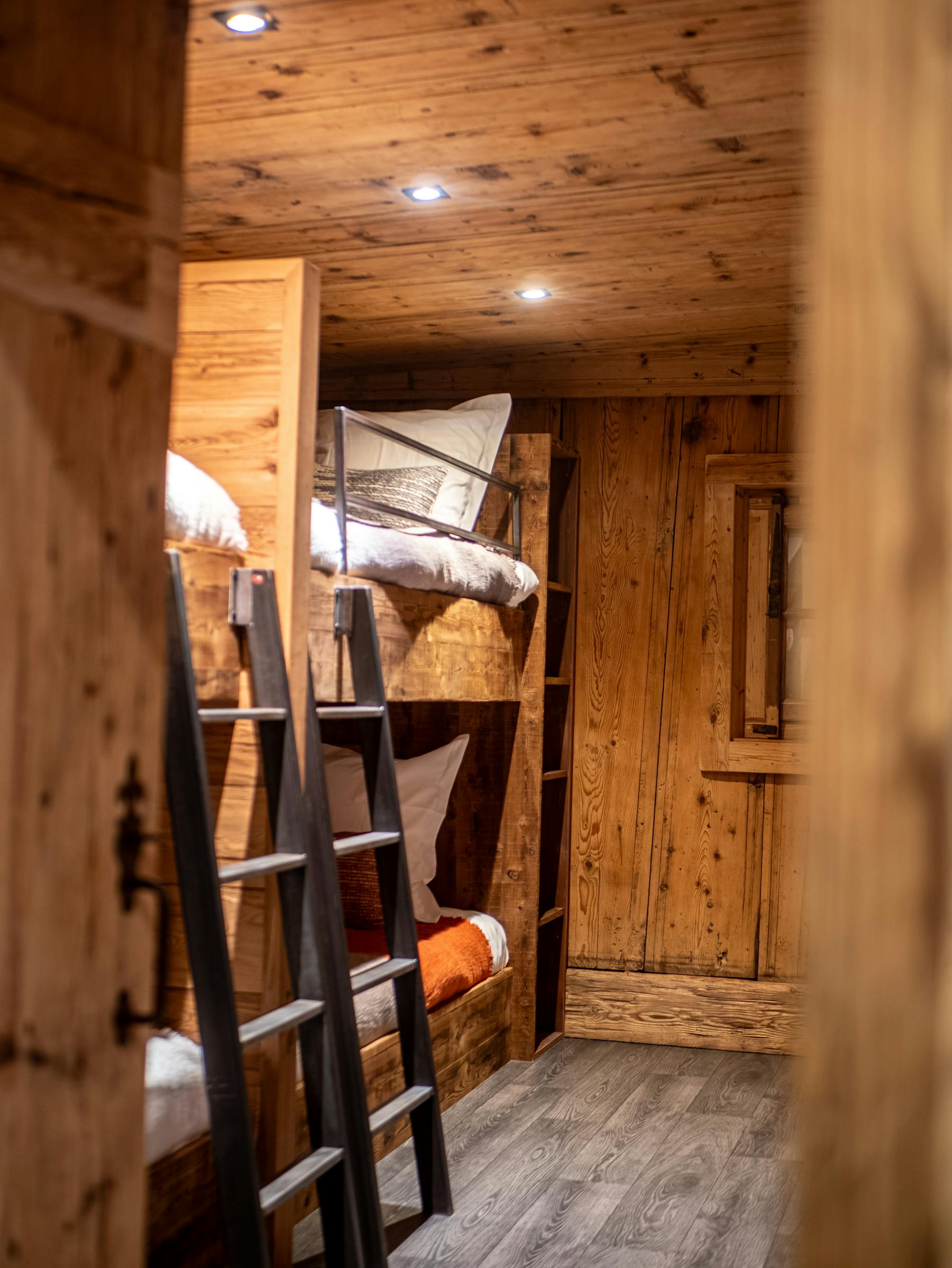
A chalet advertised for fourteen almost never sleeps fourteen adults. One Alpine agency actually publishes the adult figure: of its nineteen fourteen-bed chalets, sixteen give the number, none sleeps more than thirteen, and five sleep only ten.
- Choosing a chalet for a large group starts with a count the listing does not do for you: adults, not beds.
- Of the one agency that publishes the figure, 16 of its 19 chalets advertised as sleeping 14 give a number: every one falls between 10 and 13 adults. None sleeps 14.
- The information exists, but it sits in the property page, not in the advice article. Across five searches, eleven group-chalet guides ranked on page one and one of them mentioned bunk beds.
- A UK king is 150 cm wide, a French King Size is 180 cm, a US king is 193 cm. The same word, 43 cm apart.
- Two counts before you pay a deposit: the adults a chalet really sleeps, and the bathrooms genuinely attached to a bedroom.
Before you open a single listing, write down who is coming
The number on a listing means nothing until you have your own. And yours is not "there are fourteen of us".
Four lines are enough:
- how many adults;
- how many of them are couples who will share a double without thinking about it;
- how many will sleep alone and therefore need a bed each;
- how many children, and how old the youngest will be on the week of the trip.
If your group spans three generations, a fifth line comes before the others: who struggles with stairs. For that person the test is not how many steps separate the bedroom from the dining table, it is whether a bedroom, a bathroom and a living room sit on the same floor.
What you end up with is not a head count, it is a number of individual beds. Eight friends with no couples among them need eight separate beds; eight people forming four couples need four. Both groups search for "a chalet for 8" and they are not looking for the same house.
What "sleeps 14" does not tell you
A sleeps number adds up beds. It says nothing about what kind they are, where they sit, or who can reasonably spend a week in them.
English-language listings handle this better than most. The property pages we looked at nearly always name the bunk room, and one agency prints the split on the cards in its catalogue, in the form SLEEPS 14 (12 adults).
Of its nineteen fourteen-bed chalets, sixteen give the adult figure, and every one of those falls short of fourteen. Five sleep ten adults.
The gap is not between languages. It is between the property page and the advice article. On five separate English-language searches for group-chalet advice, eleven guides ranked on the first page of Google and only one mentioned bunk beds at all.
One British agency writes "Sleeps 8+4" on its Chamonix property page, and its own guide to group ski holidays never raises the subject. French listings are blunter still: of nineteen advertised for twelve to fourteen in the Chamonix valley in August 2026, three said how many adults the house takes.
So the detail is rarely on the page you are reading. It is one click deeper, on the property itself.
The wording that signals a spare bed
If a listing can't commit to a single number, that tells you something. Ranges, plus-signs and phrases like "children's room" all point the same way: the last beds are not like the first.
| What it says | What it means | What to ask |
|---|---|---|
| "Sleeps 10-15", "12-16 guests" | The last beds are not the same as the first | Which two or three are the last, and which room they are in |
| "Sleeps 8+4", "10 + 2", "Sleeps 17 (+3)" | The second figure is the children, the bunk room, or both | Which of the three, and where those beds sit |
| "Children's room", "family room" | Bunk beds, often narrower than a standard single | The minimum and maximum age, and the mattress width |
| "Mezzanine", "cabin", "sleeping nook" | A bed open to another room, sometimes without a window | Whether the room has a door and a window |
| "Extra bed", "sofa bed" | A bed in a living room | Who sleeps there, and when the room is free in the evening |
| "Sleeps 14 (12 adults)" | The counter-example: the house is being straight with you | The room-by-room breakdown, as everywhere else |
None of these is a fault in itself. A four-bed bunk room is a good room for four nine-year-old cousins and bad news for two couples who arrived expecting a bedroom. The problem is finding out while you hand out the keys.
Read next: Chalet in Chamonix sleeping 14: the six bedrooms one by one
Do the count yourself: how many adults, and where they sleep
The sum works on any detailed listing, and it gives you two numbers, not one.
The first is the maximum adult capacity. Every double bedroom counts as two, every twin room (two single beds) counts as two, and everything else, bunk beds, mezzanines and sofa beds, is set aside.
The second is the number of individual beds, the places where somebody sleeps alone. A single bed is worth one, a double that splits into twins is worth two, and a double that does not split is worth one. That is the figure that decides for a group with no couples in it.
The two rarely match. A house with five double bedrooms, two of which split, sleeps ten adults as couples and only seven people on their own.
Whatever is left over, bunks and sofa beds, belongs to neither total. That is spare capacity, and you decide afterwards whether your group can use it.
Take a real listing. A chalet in Haute-Savoie advertises fourteen guests and six bedrooms.
The detailed description reveals that one of the six is a four-bed bunk room: that leaves five double bedrooms, so ten adults, plus four bunk beds. The agency publishes the figure too, "10 adults", which confirms the sum.
Five bedrooms and a bunk room for four is the most common layout in houses advertised for fourteen, and it is also the layout of the chalet whose details appear further down this page.
The count does not stop at the total. You don't pick a chalet on the total, you pick it on how the beds are split up. Ten adults in five bedrooms means five couples and no slack; the same ten in seven bedrooms lets four of them sleep alone.
Ask for the list of bedrooms with, for each one, the bed type, the bathroom and the floor. Any owner who takes groups regularly will already have this written down.
Zip-and-link beds, and the trap in the word "king"
A double that splits into two singles does not change a house's adult capacity, but it changes who can occupy it. Two splitting bedrooms mean four people sleeping alone where two couples would otherwise have been needed.
This is what makes a family chalet workable for a group of friends. Several British agencies describe it as "super-king or twin", and it needs saying at the time of booking, because the beds are made up before you arrive.
Then there is the width, and this is where a British reader gets caught. The word king on its own means 150 cm in the UK and 193 cm in the US: a 43 cm spread on the same three letters.
France runs a third scale. A French King Size is 180 cm, so it matches a British super king rather than a British king, and that surprise works in your favour. The one that doesn't is lit double, which in French usually means 140 cm, close to a UK double and nothing like a king.
No listing we surveyed printed the measurement next to the name. Ask for it in centimetres.
Bonami's tip: ask about splitting beds before you ask how many bedrooms there are. Ten friends with no couples among them fit in a five-bedroom house if all five beds split, and not in a six-bedroom house where none of them does. Count the splitting beds one by one, without rounding up: it is the question that moves your shortlist the most, and almost nobody asks it.
Which floor each bedroom is on
On paper a bed is a bed. In practice it sits on a particular floor, and that is what you live with.
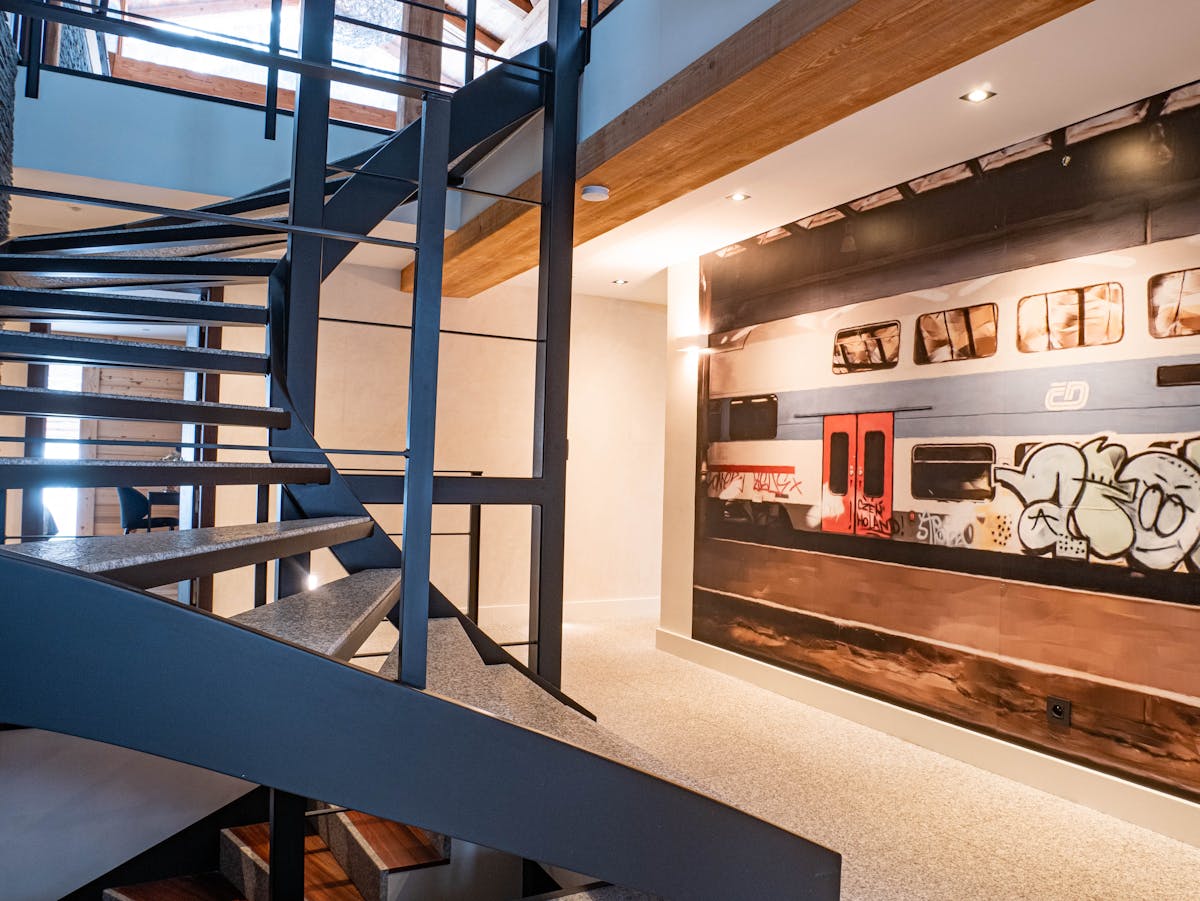
In a chalet this size the bedrooms sit across two or three levels, and the living rooms rarely share a floor with the beds. A ground-floor bedroom therefore settles nothing on its own: somebody who struggles with stairs will still climb them four to six times a day to eat. And a basement bedroom does not always have a window to the outside.
Ask for a floor plan, or failing that the list of bedrooms by level. Two questions make it readable: which bedrooms share a floor with the kitchen and the sitting room, and how many steps separate the lowest bedroom from the table.
Who gets the bunk room, and how you tell the group
The bunk room is the room that holds the bunk beds, usually on the lowest floor of the house. Then comes the decision nobody makes for you: if your group has more adults than proper bedroom beds, somebody is going down there.
The number is worked out before you book, and it is rarely round. In a house with five double bedrooms, a group of twelve sends two people to the bunk room at the very least, and up to four if it would rather put the children together.
Say it before you book, not on arrival. A group that knows what it is signing up for almost always accepts; a group that finds out while carrying the bags upstairs will talk about nothing else all week.
One marker exists, and it is written on the bed itself. This is not a French quirk: the European bunk-bed standard sets the same six-year mark, and you will find the identical warning on a bunk bed bought in the UK.
France adds a decree requiring the notice on every bed sold, in homes and in group accommodation alike. Nothing forbids putting a younger child on the top bunk, but six is the line manufacturers work to.
In a bunk room with two bunk beds, only two beds are at floor level, and those are the ones for anyone under six.
One habit settles the rest: the bunk room goes to the children when there are children, and to whoever volunteers when there are none.
Read next: Planning a ski trip with a large group: who decides what, and in what order
En-suite bathrooms, the second count
The first count decides the nights, this one decides the mornings. It is simpler and almost as badly documented.
One word causes trouble before all the others. In a listing, "en-suite" means attached to a bedroom, reached without crossing a shared landing.
In the French classification scheme the nearest term, salle d'eau privative, means something else: a shower room inside the property and reserved for its guests, wherever it happens to be. A chalet can therefore advertise "private bathrooms" in the official sense while two bedrooms share one.
Count the ones attached to a bedroom, not the bathrooms as a whole. In the same catalogue of nineteen fourteen-bed chalets, ten have fewer bathrooms than bedrooms. The most lopsided of them has seven bedrooms to four bathrooms, and advertises twelve adults.
The rule of thumb among people who let these houses is one bathroom per three or four people, and one per occupied bedroom is better. Below that the house still works, as long as the group agrees to organise its mornings.
French star ratings do not answer this question, and their absence says nothing either: having a holiday let classified is voluntary, lasts five years, and plenty of owners never bother. When they do, the official classification requires one shower room up to six guests, a second from seven, and stops there. No criterion covers a third, whatever the capacity: a fourteen-guest property can earn five stars with two shower rooms and two toilets.
The same document only awards five stars to properties where no room holds more than three beds, against four at the lower levels. A chalet with a four-bed bunk room cannot reach the top rating.
Two things almost never appear on a listing, and are worth asking. Whether the toilets are separate from the shower rooms, or whether using one means occupying somebody's shower. And whether there is a toilet near the living rooms, the one fourteen people use in the evening without going back down to the bedrooms.
The table, the sofas, and the rooms that absorb a group
A group spends its nights in the bedrooms and its evenings in two rooms. That is where size is really measured, and it is the part a photograph shows worst.
A table seating fourteen is a rare piece of furniture, even in houses advertised for fourteen. Plenty of chalets manage with a table for ten and a second one alongside, which works perfectly well as long as you know before promising everyone a family dinner. The question fits in one line: how many people sit at one table, and whether two tables push together.
The sitting room follows the same rule. Count the seats in the photographs rather than the square metres, and remember that on a bad-weather afternoon fourteen people are in that room at the same time.
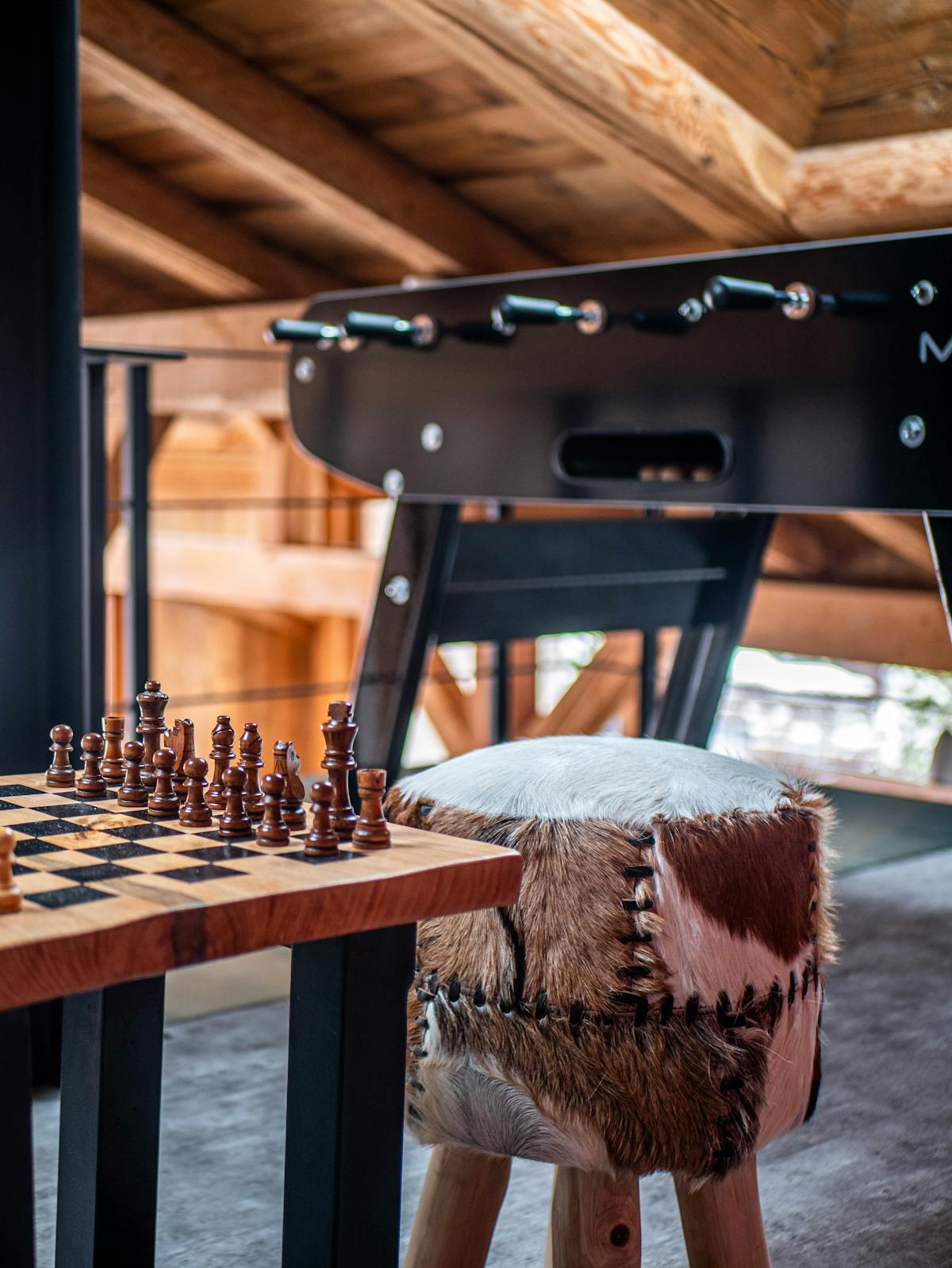
What saves a big house is the rooms where the group spreads out. A games room, a cinema room, a cellar, a room with a table football: each one takes three or four people out of the sitting room at the right moment. In a house for fourteen with nowhere else to go, everyone is always together, and that is a different week.
What to ask the owner, and what a good answer looks like
The seven questions below fit in a single message. What matters is not only the answer but the way it arrives: a house used to taking groups replies in a few lines, with numbers.
| The question | The answer that reassures | The one that should worry you |
|---|---|---|
| How many adults does the house sleep? | A figure, and what the rest of the capacity is | "It sleeps fourteen" |
| Which bed in which bedroom? | The room-by-room list, sent without hesitation | A general description of the house |
| How many beds split into twins? | The number, and how to request it | "We'll sort it out when you arrive" |
| How many bathrooms are attached to a bedroom? | The count, bedroom by bedroom | The total number of bathrooms |
| Where is each bedroom in the house? | A floor plan, or a breakdown by level | "It's all upstairs" |
| How many people at the same table? | A figure, and where the rest of the group sits | A photograph of the dining room |
| Is there a toilet near the living rooms? | Yes or no, without detour | Silence |
An evasive answer is not always a lie. More often it points to a house managed from a distance, by somebody who has never spent a week in it with fourteen people. That is already information about the stay ahead.
Here is what those seven questions give for Chalet Bonami, which sleeps up to fourteen in the hamlet of Les Bois, 3 km (2 miles) from the centre of Chamonix and 550 m from the Flégère cable car, which goes up to the nearest ski area.
Six bedrooms: five with a large double bed, plus a bunk room with four beds. Two of the five doubles split into twins and the other three do not, and it is worth telling us at the time of booking.
So the two counts read as follows. In capacity, ten adults, provided the three beds that do not split are taken by couples. In individual beds, seven people sleeping alone in a bedroom, and eleven if you use the bunk room.
Five bathrooms, each attached to a bedroom. The bunk room is the only one of the six without its own: whoever sleeps there uses one of the other five, none of which is locked or reserved for anyone. At full capacity that is one bathroom per three, plus a toilet on the living-room floor.
The bedrooms are not on one level: four on the ground floor, the fifth upstairs with the kitchen and the sitting room, the bunk room in the basement. That last one has no window to the outside, and the room doubles as the children's reading corner.
At the table, the two tables in the sitting room push together and twelve people eat at one. The last two eat at the kitchen island, which is also used for meals.
The rest depends on your dates. Bonami is let whole, with no agency in between: tell us yours and we reply within 24 hours.
Read next: Booking a chalet direct with the owner: what changes
Once the beds are settled: location, budget and the hot tub
Beds rule out a great many houses. Three criteria separate the ones left, and each deserves its own sum.
One question comes before all three, and British groups ask it first: is the house catered or not? A whole chalet let direct in France is almost always self-catered, with a chef booked separately by the evening or by the week. What catered and self-catered actually mean here is worth reading before you compare prices with a UK tour operator's package.
Location then weighs more than people expect, in a valley where the four ski areas do not link up: you cannot ski from one to the next, you come back down and drive, bus or take the train. The village you sleep in therefore decides which mountain you look at all week, and choosing where to stay in Chamonix turns on that before anything else.
Budgets compare badly from one listing to the next, because the headline price does not cover the same things. Cleaning, linen, tourist tax and utilities are included by some and not by others, and the breakdown of what a week in Chamonix actually costs reads line by line.
The hot tub is judged on what it allows a group to do, not on the photograph. A six-seat tub for fourteen people means three sittings. What to check in a chalet with a hot tub starts there.
Frequently asked questions about choosing a chalet for a large group
The questions groups of twelve and fourteen ask us before booking.
Should we book a chalet bigger than our group?
Often yes, but on a condition nobody spells out. Booking bigger only adds beds if the extra capacity is in bedrooms. If the two additional places are in the bunk room, a house for fourteen offers exactly the same adult beds as a house for twelve.
The reasoning holds when the extra space is a real bedroom. In a house meant for twelve, a group of eight uses five bedrooms instead of six and has no need of the bunk room, though eight people in five bedrooms still leaves three rooms shared, so the splitting-beds question does not go away.
The trade-off is the price, which stays that of the whole house whatever the number of guests. It is the reasoning behind groups of eight who look at larger houses, and it stops where the budget stops.
How old does a child have to be to sleep in a bunk bed?
Six for the upper bunk, and it is a warning rather than a ban. The European standard sets the mark, so the same notice appears on bunk beds sold in the UK, and France requires it on every bed placed on its market.
Listings themselves rarely set a limit, and it varies when they do: twelve most often, sometimes sixteen. Ask the question, because the answer decides how many adults you still have to place elsewhere.
Does the price drop if the group is smaller than the advertised capacity?
Almost never. A chalet is let whole, for the week, whatever the number of guests, and the rate follows the season rather than the head count. Some houses do charge certain services per person, such as meals cooked by a chef or airport transfers, and those are the only lines that move with the size of the group.
Does a baby count towards the advertised capacity?
It depends on the house, and the difference is not trivial. Some write "sleeps 14, 13 adults and 1 infant", which means the fourteenth place is a travel cot in a bedroom that is already occupied.
Others count the baby as a full guest. Ask whether a travel cot and a high chair are provided, and which bedroom the cot goes in.
Do French star ratings guarantee an en-suite for every bedroom?
No. The classification for furnished holiday lets requires one shower room up to six guests and a second from seven, and never imposes a third.
A five-star property can therefore sleep fourteen people with two shower rooms. The rating measures a level of equipment and service, not how comfortable a house is for a large group: the count of en-suite bathrooms is still yours to do.